Retail Beverage Distributor Reduced Lost Freight Charges By 50% With GLSS
Home » Case Study » Retail Beverage Distributor Reduced Lost Freight Charges By 50% With GLSS
LOCATION
Canada
INDUSTRY
Retail
FUNCTION
Operations
IMPROVEMENT
50%
PROJECT SUMMARY
The problem: A retail beverage distributor faced frequent billing errors, with 20–30% of invoices missing freight charges, leading to lost revenue and inconsistent customer experiences.
With GLSS, this retail beverage distributor reduced missed freight charges to approximately 12%, improving billing accuracy by about 50% while decreasing rework and strengthening customer trust.
INTRODUCTION
Retail beverage organizations operate in a fast-moving environment where tight margins, high customer expectations, and complex field operations leave little room for error. Even small billing inconsistencies can quickly add up to lost revenue and eroded trust. Recognizing this risk, a large retail beverage distributor turned to GLSS’s Lean Six Sigma Green Belt Training & Certification to build practical problem-solving skills and lead a focused improvement effort. Guided by Ethical Efficiency™, the team was committed to improving financial performance while also making the process clearer, fairer, and easier for employees to follow.
The initiative was led by a project leader who applied GLSS’s structured, real-world approach to address billing accuracy issues without adding unnecessary burden to frontline teams.
THE PROBLEM
The organization identified a recurring issue in its invoicing process: freight charges were frequently missing from customer invoices generated by field installation teams. These omissions resulted in unbilled services, lost revenue, and inconsistent customer experiences. Early analysis showed that 20–30% of invoices failed to include applicable freight charges.
Beyond the immediate financial impact, the issue created additional downstream problems. Finance teams spent extra time correcting invoices, field teams lacked clarity on expectations, and the organization faced a higher risk of customer disputes. Without a consistent and reliable process, the problem continued to repeat, highlighting why structured process improvement was critical to long-term success.
THE ROOT CAUSES
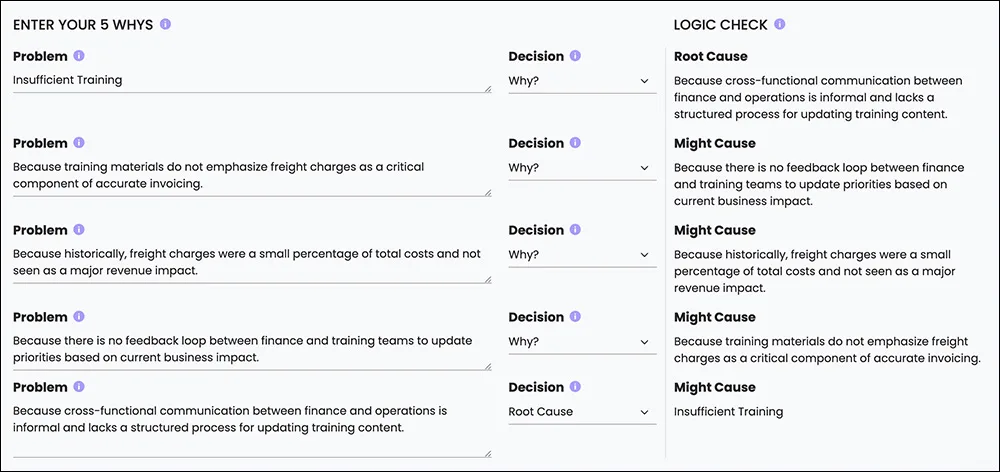
The project team uncovered several contributing factors. First, communication between finance and operations was informal and inconsistent. Updates to billing requirements were not always reflected in training materials or clearly communicated to field teams.
Second, there was no KPI or reporting mechanism to track how often freight charges were missed. Without visibility, the issue stayed largely hidden and reactive rather than proactively managed.
Finally, the invoicing process relied heavily on individual memory. While staff were expected to include freight charges when applicable, the system itself did not prompt or require this step, making errors more likely during busy workdays.
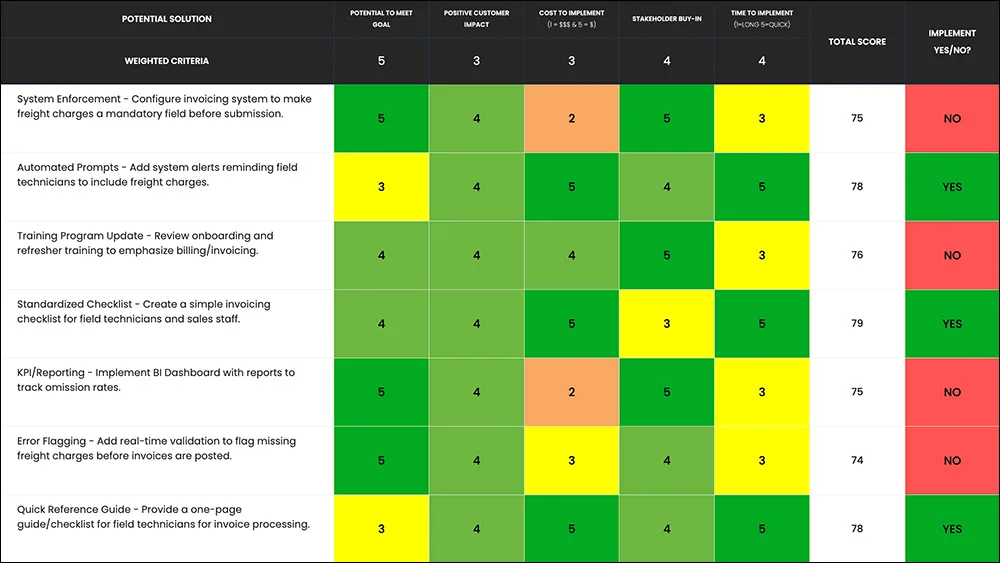
To address these gaps, the team implemented several practical, people-centered solutions. Automated prompts were added to the invoicing system to remind technicians when freight charges applied, reducing reliance on memory and guesswork.
A standardized invoicing checklist was also introduced for field technicians and sales staff. This simple tool clarified required invoice elements and reinforced a consistent process across teams.
In addition, the team created a one-page quick reference guide that technicians could easily use in the field. Designed for clarity and speed, it supported correct invoice completion without slowing down operations, an important Ethical Efficiency consideration.
To automate the creation of the Solution Selection Matrix, try Kure.
THE RESULTS
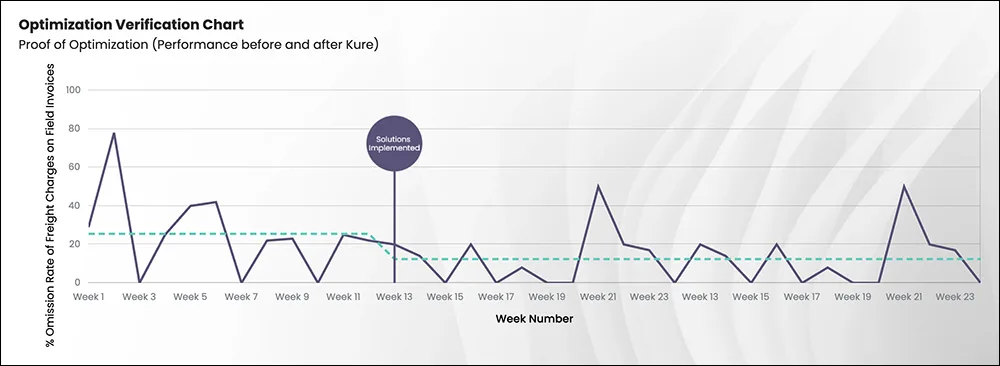
The improvements delivered clear, measurable impact. Freight charge omissions were reduced from 20–30% down to approximately 12%, representing roughly a 50% improvement in billing accuracy. Lost revenue declined, manual rework decreased, and invoice consistency improved, strengthening customer trust.
Just as importantly, the solutions created a scalable foundation. Mandatory invoice fields can now be extended to other critical items such as taxes or discounts. KPI tracking enables ongoing monitoring of additional cost elements, and standardized checklists support consistency across warehouse, sales, and field operations.
To automate the creation of the Verification Chart, try Kure.
Start improving with GLSS
Through GLSS Green Belt Training & Certification, this retail beverage distributor leveraged innovative instructional design and hands-on improvement tools to achieve results faster and more sustainably. The project empowered teams to uncover root causes, implement smart system-based solutions, and build controls that last.
By applying Ethical Efficiency™, the organization improved financial outcomes while also making work easier and clearer for employees. This successful initiative not only reduced freight revenue leakage, but also positioned the organization for future improvement efforts, with stronger alignment, better visibility, and a proven framework for operational excellence.
*We value our clients’ confidentiality. While we’ve changed their names, the results are real.
Start a free trial and get access to all GLSS courses (Yellow Belt, Green Belt, Black Belt, and more!) for only $499/year with a GLSS Subscription!