

Culture First, Results Always: Building a Culture of Ethical Efficiency™ With Process Transparency
A Multi-Property Resort and Hospitality Operation | Principals of Strategy Elevation Alliance in Collaboration with GLSS + The Leadership Challenge®
Home » Case Study » Culture First, Results Always: Building a Culture of Ethical Efficiency™ With Process Transparency
United States
Professional Services
Operations
Company-wide
A multi-property resort and hospitality operation set out to build a culture with efficiency and process transparency, not by mandating process changes from the top, but by first answering a harder question: what does it take for people to genuinely want to improve?
The answer unfolded across three interdependent conditions.
- First, people needed to feel safe enough to speak up and challenge the way things were done.
- Second, they needed the tools, language, and skills to actually improve processes.
- Third, those new behaviors and capabilities needed to be recognized, reinforced, and embedded so they would last.
By sequencing The Leadership Challenge® (TLC) as the cultural and behavioral foundation, GLSS (GoLeanSixSigma.com) as the process improvement engine for transparency and efficiency, and a deliberate recognition architecture to sustain both, the organization achieved a transformation that is measurable, replicable, and fully aligned with the principles of Ethical Efficiency™: responsible innovation that strengthens trust, uplifts people, and delivers sustainable results.
This multi-property resort and hospitality operation had approximately 2,000 team members and had experienced strong growth. But rising labor costs, increasing market pressure, and a plateau in revenue growth were signaling that the organization needed to shift, from dependence on individual knowledge and heroic effort to standardized, transparent, and efficient operations.
The challenges were interconnected and deep:
- Entrenched habits: Team members had performed their roles the same way for years with no shared framework for improvement or process thinking.
- A culture of hierarchy: People did not feel safe speaking up. Challenging the way things were done was not the norm.
- Governance gaps: Leadership had limited formal management training and no unifying set of values or behavioral expectations.
- No common language: Without shared vocabulary or tools, collaboration across departments was difficult and improvement efforts rarely stuck.
- Legacy technology: Outdated systems limited visibility, accountability, and the ability to measure performance consistently.
The management team knew that a one-time fix would not work. What was needed was a cultural shift, one that embedded new behaviors, built new capabilities, and created new habits at every level of the organization.
Lasting improvement requires a foundation that most organizations overlook: people must trust that it is safe to tell the truth, raise concerns, and challenge the way things are done. Efficiency built on silence is fragile. Integrity must come first. That insight shaped the starting point of this transformation.
Before any process tool was introduced, the organization invested in The Leadership Challenge® (TLC), the globally recognized leadership development framework grounded in 40 years of research across more than 700 studies and a database of over 8 million leaders in 120 countries. TLC’s Five Practices of Exemplary Leadership, Model the Way, Inspire a Shared Vision, Challenge the Process, Enable Others to Act, and Encourage the Heart, became the operating architecture for change.
Model the Way: Establishing Values as the Behavioral Foundation
Transformation began at the top. The executive leadership team was the first to engage with The Leadership Challenge®, starting with the Leadership Practices Inventory (LPI) self-assessment, a full year before receiving 360-degree feedback from others. This sequencing was intentional: it built self-awareness and reduced defensiveness before leaders were asked to be assessed by their teams.
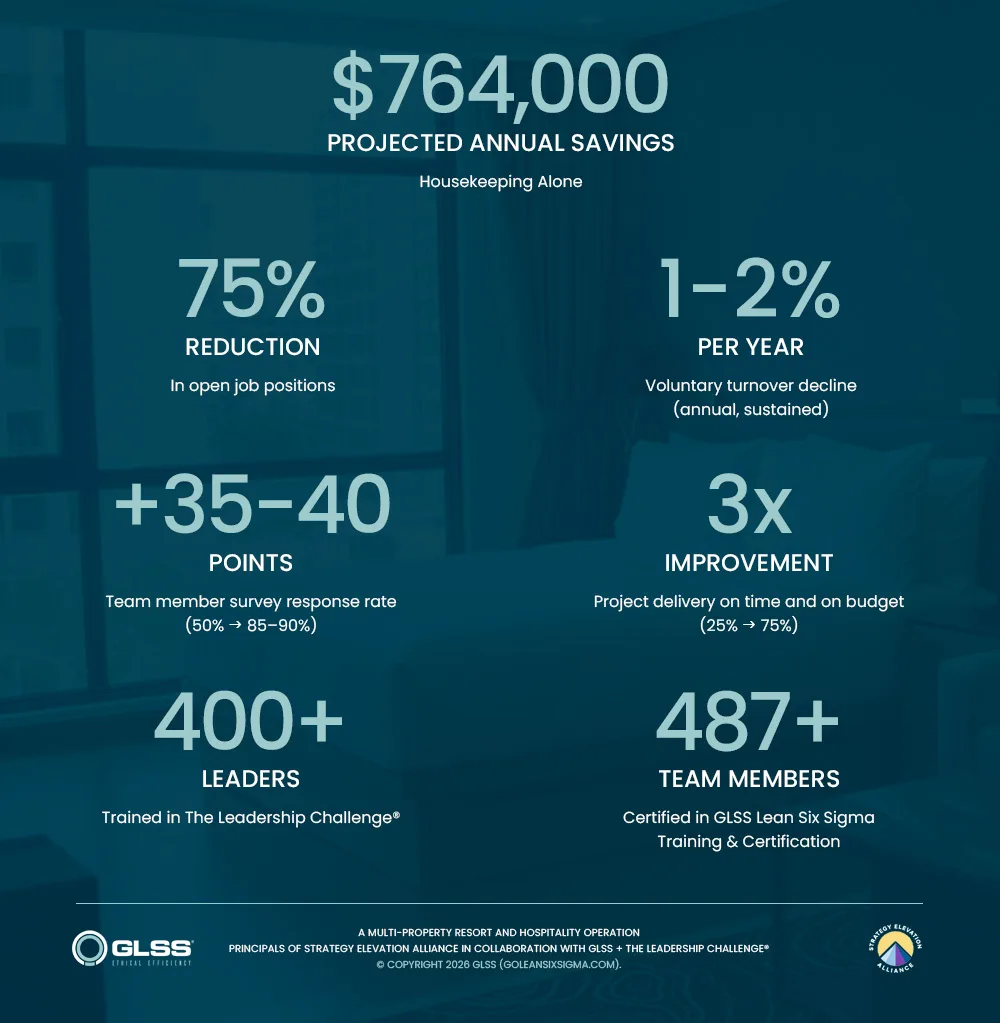
This cascade approach, starting with the most senior leaders and moving level by level through Executive Directors, Directors, and finally Managers and Supervisors, reached more than 400 leaders over several years. It disarmed skepticism at each level before moving deeper into the organization.
A critical early outcome was the codification of organizational values. Enterprise business values, including Respect, Customer Care, Continuous Improvement, Accountability, and Integrity, gave leaders and team members a shared language for what it meant to belong to the organization and how to conduct themselves in every interaction.
Inspire a Shared Vision: Making the Future Real
With values clarified, the organization created and shared a compelling vision of its future, translating abstract strategic intent into emotional, visual storytelling that team members at every level could see themselves in. Vision videos, nested vision statements from enterprise to department level, and a single-page strategic framework gave every leader a clear line of sight from their daily work to the organization’s larger purpose.
Challenge the Process: Giving People Permission and a Voice
Perhaps the most transformative outcome of TLC’s early phases was this: the organization formally declared that challenging the process was not disrespectful, it was expected.
By embedding Continuous Improvement as a core organizational value and teaching TLC’s third practice, Challenge the Process, team members gained both permission and specific language. Phrases like “I would like to challenge the process” became acceptable, even encouraged. What had previously felt like insubordination was reframed as professional courage and organizational stewardship.
This was the critical unlock. No process improvement methodology can succeed if the people closest to the work are afraid to identify what is broken. TLC built the psychological safety that made everything that followed possible.
THE LEADERSHIP FOUNDATION IN PRACTICE:
By the time the organization was ready to introduce Lean principles, it had already done something far more difficult: it had changed the culture. People trusted their leaders. Leaders modeled transparency and accountability. And the organization had a shared language for what continuous improvement meant and why it mattered.
THE LEADERSHIP FOUNDATION IN PRACTICE:
By the time the organization was ready to introduce Lean principles, it had already done something far more difficult: it had changed the culture. People trusted their leaders. Leaders modeled transparency and accountability. And the organization had a shared language for what continuous improvement meant and why it mattered.
With psychological safety established and Continuous Improvement embedded as a core value, the organization was ready for the second condition: giving people the capability to actually do the work of improvement.
This required two things in parallel: a common framework for understanding how work gets done, and a structured training program that built improvement skills at every level of the organization.
A Process Framework: The Foundation for “How We Work”
The organization adopted the American Productivity and Quality Center (APQC) Process Classification Framework (PCF), a globally recognized model that organizes all enterprise activities into Operating Processes (those that directly create value) and Management and Support Services (those that enable the organization to function).
Critically, the framework was customized to reflect the specific nature of this multi-property hospitality operation, rather than applied generically. This gave every leader, from frontline supervisor to senior executive, a shared vocabulary for identifying, prioritizing, and acting on process improvement opportunities. Processes were then scored by maturity and business volume, creating a data-driven prioritization system for where to focus improvement energy first to drive efficiency and process transparency.
The GLSS Collaboration: Building a Pyramid of Capability
To build the process improvement capability the organization needed, it collaborated with GLSS, a global enterprise learning platform whose approach to improvement is grounded in a principle that resonated deeply with this organization’s values: that efficiency and integrity are not competing forces, they are mutually reinforcing ones.
GLSS’s commitment to responsible innovation, uplifting communities, and cultivating ethical leadership that delivers sustainable prosperity aligned perfectly with an organization that had already embedded Integrity and Accountability as core values. The goal was not just to eliminate waste, it was to build an enduring capability for principled, people-centered improvement.
GLSS designed the certification program as a cascade, building capability at every level of the organization:
- Yellow Belt (400+ participants): Line-level team members and supervisors built foundational awareness of waste, process flow, and continuous improvement principles through project-based learning.
- Green Belt (75 participants): Managers and executives developed structured project management and process improvement skills to lead cross-functional change efforts.
- Black Belt (11 participants): Program leaders gained advanced analytical and project leadership capability, serving as internal coaches for complex initiatives.
- Master Black Belt (1 Certified, 1 Understudy): Strategic oversight and enterprise governance were anchored at the senior level, with succession planning built in from the start.
- Champion (1 CxO): C-suite sponsorship ensured direct alignment between the improvement program and organizational strategy.
In total, more than 487 team members were trained across all belt levels, creating a shared improvement language that reached from the frontline to the C-Suite.
Applying the Capability: Kaizen Events in Action
With certified practitioners and a common process framework in place, the organization launched 14 Kaizen events across 30+ departments and properties, focused, short-duration improvement projects (typically 3 to 5 days) designed to eliminate waste and rapidly improve specific processes.
The results from one example, a housekeeping operations Kaizen across three hotel properties, demonstrate the power of this approach when GLSS’s methodology is applied to a workforce that is genuinely empowered to speak up:
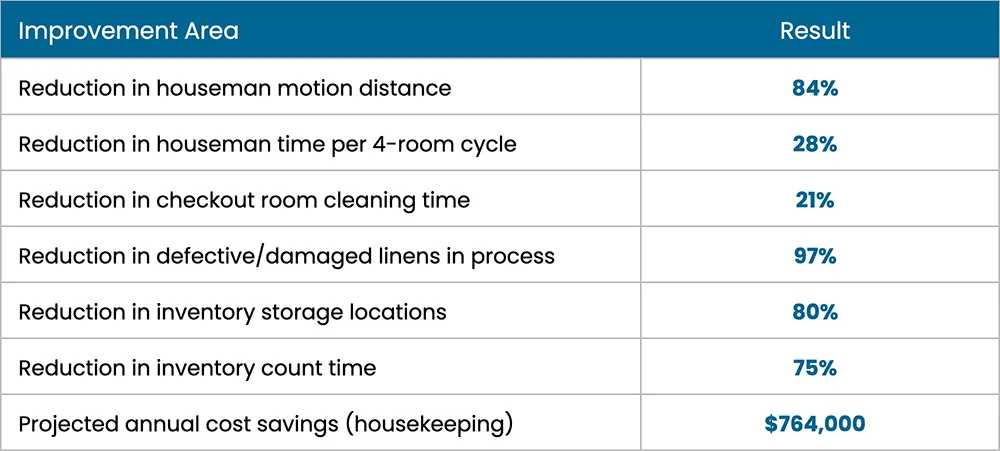
As one housekeeping supervisor put it: “Kaizen means good changes, which translates to continuous improvement. So that’s what we did.” Those words capture what values-driven improvement looks like in practice, frontline team members, empowered with knowledge and trusted by their leaders, driving real and lasting change.
WHY THE SEQUENCE MATTERS:
GLSS brought world-class Lean Six Sigma capability to this organization. But capability without culture is fragile. The reason these Kaizen events succeeded, and the reason those results stuck, is that TLC had already done the foundational work. People were not just trained to improve processes. They believed it was safe to do so, they understood why it mattered, and they had leaders at every level who modeled the behaviors the work required.
WHY THE SEQUENCE MATTERS:
GLSS brought world-class Lean Six Sigma capability to this organization. But capability without culture is fragile. The reason these Kaizen events succeeded, and the reason those results stuck, is that TLC had already done the foundational work. People were not just trained to improve processes. They believed it was safe to do so, they understood why it mattered, and they had leaders at every level who modeled the behaviors the work required.
The third condition for lasting transformation is also the most often overlooked: people need to see that their efforts are noticed, valued, and celebrated. Without reinforcement, even the most capable and well-intentioned improvement programs quietly fade.
TLC’s fourth and fifth practices, Enable Others to Act and Encourage the Heart, became the architecture for sustainability.
Enable Others to Act: From Asking Permission to Taking Ownership
As the TLC cascade deepened to reach all managers and supervisors, one of the most significant cultural shifts became visible: the organization was moving from highly centralized decision-making to genuine delegation of authority and accountability.
Team members described the change in their own words, sharing stories of feeling empowered to make decisions, of building trust with their teams, and of the shift from “asking permission” to “informing after deciding within their scope.” These were not abstract leadership concepts. They were lived daily realities.
To ensure long-term sustainability, the organization invested in developing two internal Certified Master Facilitators and six additional Certified Facilitators from within its own ranks. This was a defining decision: it replaced consultant dependency with internal capability, ensuring that the leadership culture could be nurtured and grown without external support.
Encourage the Heart: Making Values Visible
Recognition was deliberately tied to values, not just performance metrics. The organization implemented multiple recognition practices that made its values tangible rather than abstract:
- Handwritten notes: Leaders personally wrote thank-you notes to team members, reinforcing specific behaviors aligned to organizational values.
- Video storytelling: Team members from all levels appeared in authentic, unscripted videos demonstrating what values like Respect looked like in real workplace moments.
- Promotions tied to values: Demonstrating leadership behaviors became an explicit criterion in promotion decisions, embedding the cultural expectations into the talent system.
- Department-level celebrations: Small wins in process improvement were recognized at the team level, reinforcing that continuous improvement was everyone’s responsibility.
This architecture of recognition closed the loop. When people see that speaking up leads to improvement, and that improvement leads to recognition, the commitment to integrity and continuous improvement becomes self-reinforcing.
A Proven and Replicable Model
This transformation did not begin with a process problem. It began with a leadership question: how do we build an organization that is transparent, accountable, and capable of improving itself, continuously and sustainably?
The answer required sequencing the work correctly. The Leadership Challenge® came first, establishing the values, the trust, and the psychological safety without which no improvement effort can succeed, and without which integrity cannot be practiced rather than merely stated. GLSS came second, equipping people with the methodology, the language, and the certified expertise to turn that safety into action. Recognition and reinforcement came third, ensuring that what was built would last.
The result is an organization that is not only high-performing, but principled and enduring, delivering long-term benefits for its people and the communities it serves. When integrity is the foundation and capability is the engine, continuous improvement becomes a culture, not a program.
For organizations committed to transparency, accountability, and sustainable growth, this model offers a proven and replicable path forward. The results speak for themselves.
John Elliott, Strategy Elevation Alliance
John Elliott is an Australian native and U.S. citizen whose career spans forty years across two continents. He spent twenty years with Andersen, rising to COO Asia Pacific, before relocating to the United States where he spent the next twenty years in CEO roles leading large, complex business operations. His leadership philosophy is grounded in his “3L’s” framework, Listen, Look, and Learn, reflecting a deep commitment to giving back and making a lasting difference in the lives of the people he serves. John is an Advanced Facilitator of The Leadership Challenge.
Teri Hill, Strategy Elevation Alliance
Teri Hill brings Fortune 500 methodologies to small and mid-sized organizations, drawing on her career as a Managing Director in Organizational Strategy at Accenture. Her work integrates Line of Sight strategy alignment, Predictive Index behavioral analytics, and The Leadership Challenge to help leaders build organizations that are strategically clear, people-smart, and execution-ready. Teri is an Advanced Facilitator of The Leadership Challenge.
Tommy Rhoads, Strategy Elevation Alliance
Tommy Rhoads is a proven leader in hospitality, tribal enterprises, and corporate transformation with deep expertise in aligning strategy with execution and building resilient, people-centered organizations. A Lean Six Sigma Master Black Belt and Authorized GLSS Partner, his career impact spans enterprise transformation at scale, including measurable results in customer and employee experience, operational excellence, and M&A value realization. His leadership philosophy centers on authenticity, teamwork, courage, service, and holistic well-being, creating stronger organizations where people thrive.
