


Food Manufacturer Reduced Package Weight Variation By 44% And Unlocked $757K In Annual Savings With GLSS
Home » Case Study » Food Manufacturer Reduced Package Weight Variation By 44% And Unlocked $757K In Annual Savings With GLSS
Mississippi
Manufacturing
Operations
44%

Cesar Escobar Lobo
Continuous Improvement Manager
- The problem: The premium nuggets product—representing 27% of total production—was experiencing significant product giveaway due to inconsistent bag weights, non-standard machine settings, and lack of standardized responses, making variation reduction critical to protecting margins and reducing waste at scale.
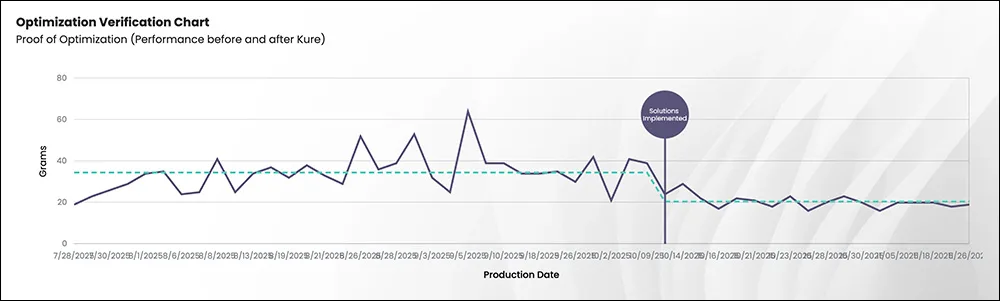
- By implementing standardized bagger-level data tracking and more frequent weight checks, the team reduced average bag weight variation from 36 grams to 20 grams (44% reduction), improved yield by 4–5%, and positioned the operation to recover 526,000 pounds annually—equivalent to approximately $757,000 in savings and a 2% yield gain.
A leading food manufacturer is a fourth-generation, family-owned poultry processing company with more than 7,500 team members and 20 facilities across the Southeast. With operations spanning multiple states, the organization has grown from a small hatchery and feed mill into a globally recognized supplier known for customer satisfaction and total quality management.
Like many food processing organizations, this food manufacturer operates in a highly competitive environment where even small variations in weight or consistency can create significant financial impact. Tight margins, high volumes, and strict quality standards make process improvement not just beneficial—but critical to long-term success.To meet this challenge, the organization selected GLSS’s Lean Six Sigma Green Belt Training & Certification to guide a structured improvement effort grounded in Ethical Efficiency™—balancing measurable results with respect for people, product integrity, and customers.
With practical, easy-to-apply improvement methods and data-driven thinking, the team launched the Package Weight Variation Reduction project, led by Project Team Lead Cesar Escobar Lobo, to improve yield, reduce waste, and strengthen process control across a high-volume product.
Their premium nuggets product represents 27% of total plant production, with an expected volume of 25.8 million pounds in 2025. On Lines 1 and 3, packout yield averaged 165%, signaling significant product giveaway driven by variation in bag weights and inconsistent subline performance.
Non-standard machine settings and inconsistent responses to weight variation made it difficult to maintain control. Without clear standards or consistent reactions, valuable product was being given away on one of the plant’s highest-volume items. For an operation of this scale, reducing variation was critical to protecting margins, minimizing waste, and sustaining long-term success.
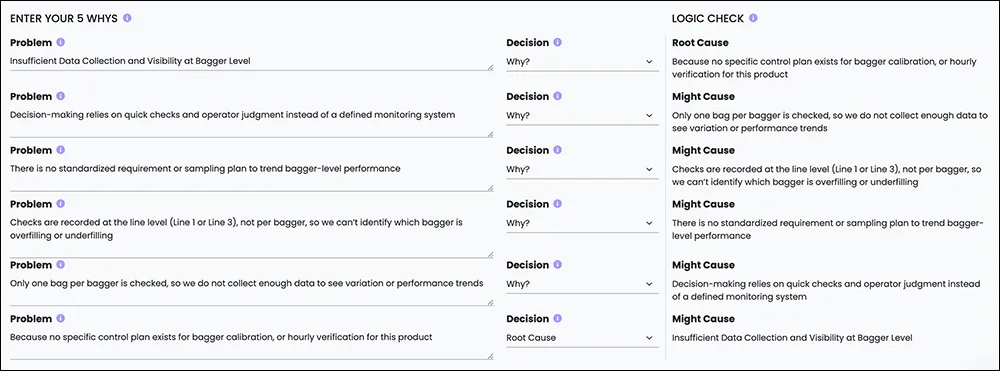
One root cause was the lack of a defined control plan for bagger calibration and hourly verification specific to their product. Without routine, standardized checks, bag weights were able to drift without timely correction.
A second root cause was the absence of a clear reaction plan when piece-weight data showed upward or downward trends. Even when data signaled an issue, there was no consistent expectation for real-time adjustments to breading or fryer settings.
A third root cause was the lack of a documented, shift-independent control plan. Different shifts responded differently to weight or piece-count issues, creating inconsistency and continued giveaway.
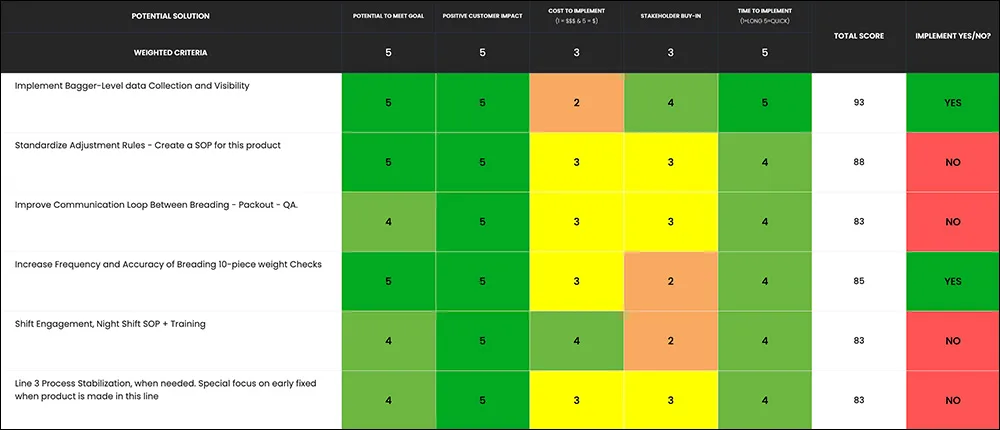
One solution was implementing bagger-level data collection and visibility. This allowed operators and supervisors to see performance by machine, quickly spot variation, and respond before losses grew.
Another solution was increasing the frequency and accuracy of breading 10-piece weight checks. More frequent and reliable checks helped teams detect weight drift earlier and take corrective action faster.
Together, these solutions reinforced standard work, improved coordination between breading and packout teams, and created clearer expectations for how to respond when variation appeared.
The project delivered fast, measurable results. Average bag weight variation was reduced from 36 grams to 20 grams, representing a 44% reduction in variation. Yield improved by 4–5% over the most recent two-week period, clearly demonstrating the financial value of better standardization and control.
These improvements position the operation to recover an estimated 526,000 pounds annually, equivalent to approximately $757,000 in savings and a 2% yield gain across their product. Just as importantly, standardized checks and stronger communication are now consistently applied across shifts, supporting sustained performance.
with GLSS
Through GLSS Training & Certification, this food manufacturer applied innovative instructional design and practical improvement tools to achieve meaningful results—quickly and sustainably. The project team was able to identify root causes, standardize controls, and embed Ethical Efficiency™ by reducing waste while protecting product quality and supporting frontline teams.
This successful project not only reduced package weight variation and improved yield, but also positioned the organization for future success. With stronger process discipline, improved cross-team collaboration, and a proven improvement framework, this organization is well equipped to continue driving operational excellence and responsible growth across its food processing operations.
*We value our clients’ confidentiality. While the company name may be anonymous, the results are real.