Manufacturer Decreased Cable Assembly Defects By 80% With GLSS
Home » Case Study » Manufacturer Decreased Cable Assembly Defects By 80% With GLSS
LOCATION
United States
INDUSTRY
Manufacturing
FUNCTION
Operations
IMPROVEMENT
80%
PROJECT SUMMARY
The problem: This manufacturer was experiencing a growing number of cable assembly defects that were increasing scrap, driving rework, and impacting production efficiency.
With GLSS, this manufacturer reduced average open circuit defects from 6.5 defects per week to 1.3 defects per week, an 80% improvement in process performance and quality consistency.
INTRODUCTION
This manufacturer is known for producing advanced tactical equipment and defense solutions for military, law enforcement, and commercial applications. In an industry where reliability and precision are essential, even small process inconsistencies can create costly quality issues and production delays.
To strengthen quality performance and reduce waste, this manufacturer turned to GLSS’s Lean Six Sigma Green Belt Training & Certification. The organization wanted a practical and structured approach that would help the team quickly identify root causes and implement sustainable improvements. The team applied GLSS tools to simplify the process, improve consistency, and create more reliable outcomes.
The project also reflected the principles of Ethical Efficiency™, which focuses on improving performance while supporting people, quality, and long-term operational success. Rather than relying on short-term fixes, the team focused on building a process that operators could follow consistently and confidently.
THE PROBLEM
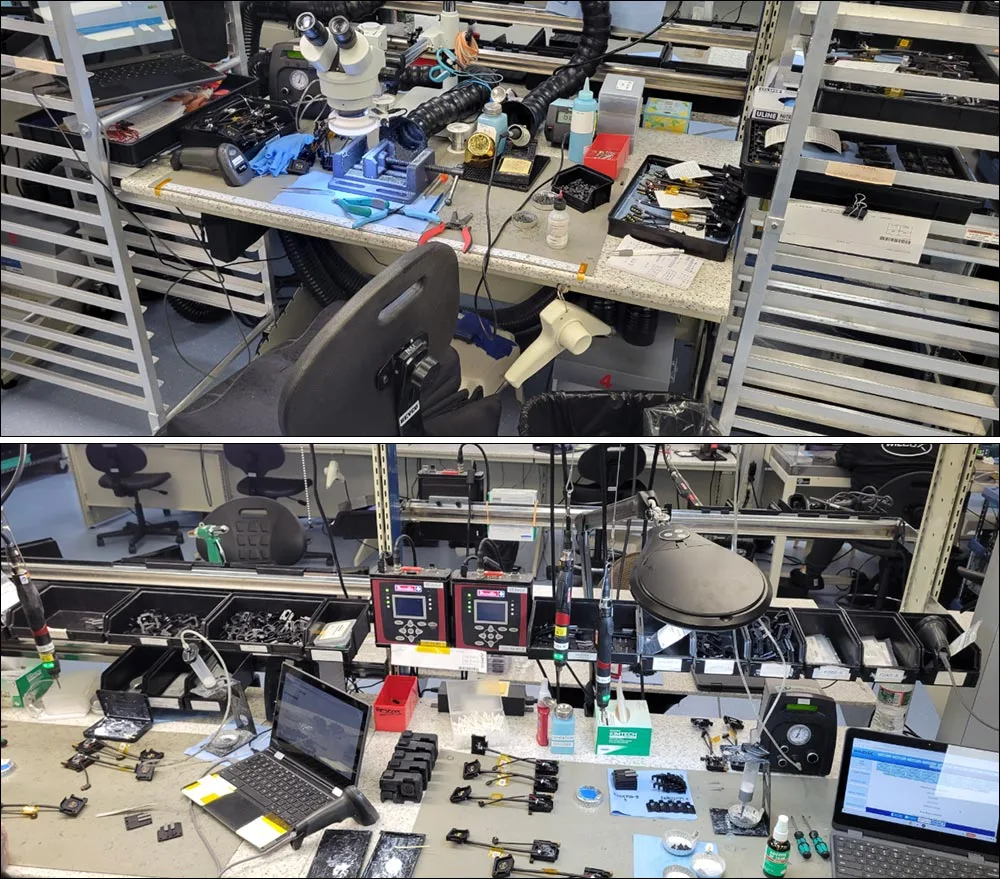
The production team was experiencing a high number of open circuit defects in cable assemblies. These defects had become the leading contributor to scrap year-to-date, increasing material waste, rework, and production costs.
An open circuit defect meant the electrical connection within the cable assembly was incomplete, making the product unusable. As the number of defects increased, production teams faced additional pressure to keep schedules on track while also managing higher levels of waste and inefficiency.
For manufacturing organizations operating in highly competitive industries, process improvement work is critical. Defects not only increase operational costs, but they can also impact product reliability, customer satisfaction, and overall business performance. The organization recognized that reducing variation and improving consistency would be essential to maintaining high quality standards and supporting long-term growth.
Before
THE ROOT CAUSES
After analyzing the production process, the team identified several factors contributing to the defects.
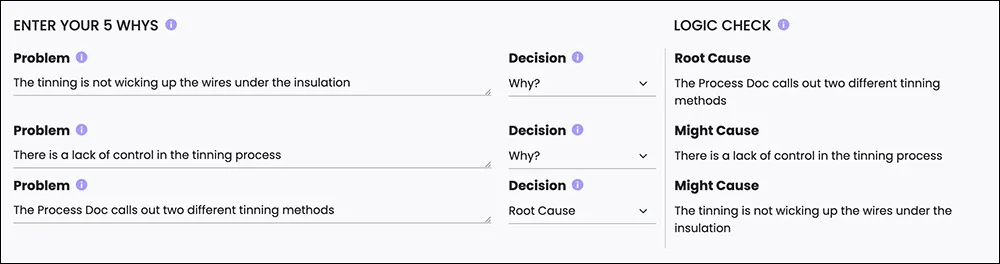
First, the process documentation allowed for two different tinning methods. Because operators were using different approaches, the process lacked consistency, creating variation in the final product.
Second, the existing tinning method required operators to heat the solder cup with an iron while hand-feeding solder into the connection. This approach often resulted in inconsistent wire encapsulation inside the hot shoe, affecting connection quality.
The team also discovered that the cable strip length did not properly account for the bend radius required to position the wires correctly inside the solder cup. This made it more difficult to create a strong and reliable connection during assembly.
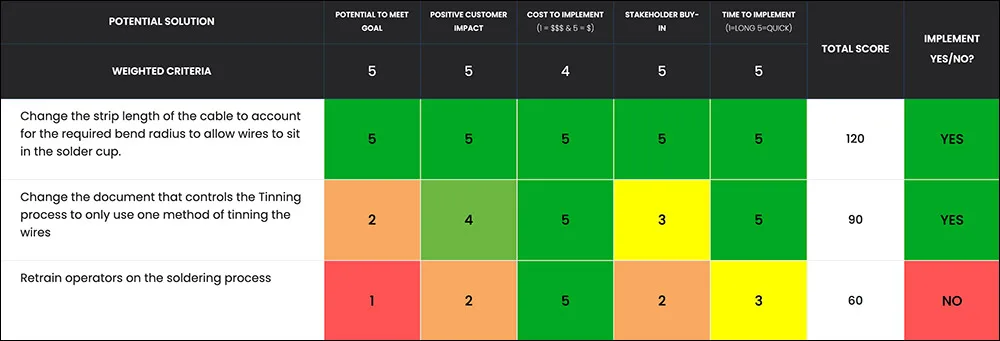
Using the tools and structured problem-solving methods learned through GLSS Training & Certification, the team implemented two targeted improvements.
Adjusted Cable Strip Length: The cable strip length was modified to better account for the necessary bend radius. This allowed wires to sit properly within the solder cup and improved overall connection quality.
Standardized the Tinning Process: The team updated process documentation to define one consistent tinning method for all operators. By eliminating variation in how the work was performed, the process became more stable and repeatable.
While the changes were straightforward, they directly addressed the root causes driving the defects.
To automate the creation of the Solution Selection Matrix, try Kure.
THE RESULTS
The improvements delivered immediate and measurable results.
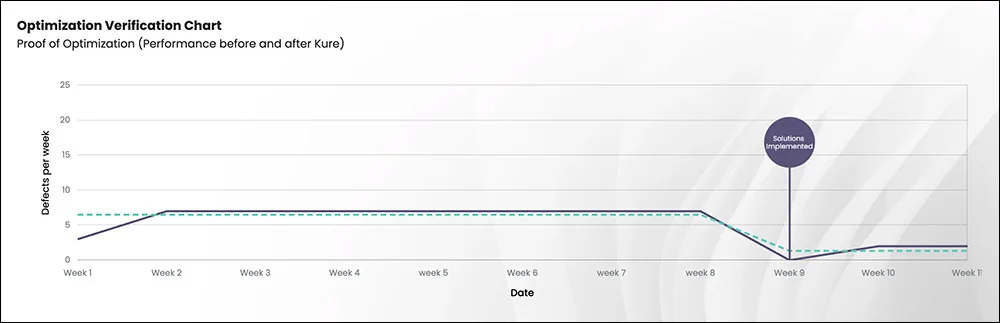
Average open circuit defects decreased from 6.5 defects per week to 1.3 defects per week, resulting in an 80% reduction in defects.
The process also became significantly more stable, remaining within ideal control limits after the improvements were implemented.
As defects decreased, the organization experienced lower scrap and rework levels, improved production flow, and greater confidence in process consistency. Operators were able to follow a clearer and more standardized process, helping create more reliable outcomes across production.
To automate the creation of the Verification Chart, try Kure.
Start improving with GLSS
This project demonstrates how focused process improvement efforts can create meaningful operational results in manufacturing environments. By identifying root causes, reducing variation, and simplifying key process steps, the manufacturer successfully improved cable assembly quality while significantly reducing defects.
GLSS Training & Certification played an important role in helping the team achieve results quickly. Its innovative instructional design and practical approach enabled the team to move from problem identification to implementation efficiently and effectively.
The project also reinforced the value of Ethical Efficiency™ by showing how process improvements can strengthen both operational performance and the employee experience. With a more stable and reliable process now in place, this organization is well positioned to continue improving quality, reducing waste, and driving long-term manufacturing success.
After
*We value our clients’ confidentiality. While the company name may be anonymous, the results are real.
Start a free trial and get access to all GLSS courses (Yellow Belt, Green Belt, Black Belt, and more!) for only $499/year with a GLSS Subscription!