


When I think about leadership, I do not begin with a title, an organizational chart, or a financial target. I begin with stewardship.
Leadership is the responsibility to leave people, institutions, and communities stronger than we found them. For me, that responsibility has been shaped by my own life, by the people who invested in me, and by the privilege of working with tribal nations whose view of success reaches far beyond the next quarter.
In the corporate world, leaders often speak in three-to-five-year planning cycles. In tribal enterprises, the horizon is generational. Financial performance matters, but it is not the whole story. The work also carries language, culture, education, health care, community well-being, and opportunity for the next generation. That changes how you lead. It requires patience, perseverance, humility, and a deep respect for the culture that already exists before you arrive.
When I stepped into the CEO role in early 2020, I did not come in with a ready-made answer. I came in with a philosophy: listen, look, learn, lead, legacy. I spent my first weeks talking with team members, asking about their challenges, their aspirations, and what they would change if they could wave a magic wand. What I heard repeatedly was that people felt part of the family. They described a culture of belonging, care, and mutual responsibility. I knew then that our task was not to invent a culture. It was to build a stronger business culture on the foundation of a family culture that was already alive.
Family Culture Is Not Soft. It Is Operational.
A strong family culture is not a substitute for business discipline. It is a foundation for it. In families at their best, people expect integrity. They expect respect. They hold one another accountable. They care for one another. They try to be better tomorrow than they were today. Those are not sentimental ideas. They are operating principles.
We translated that foundation into One Team: one tribe, one mission, one set of outcomes. We define that culture through 20 behaviors organized into four categories. These are not just words for a wall. They are the behaviors we train, measure, reward, and expect.
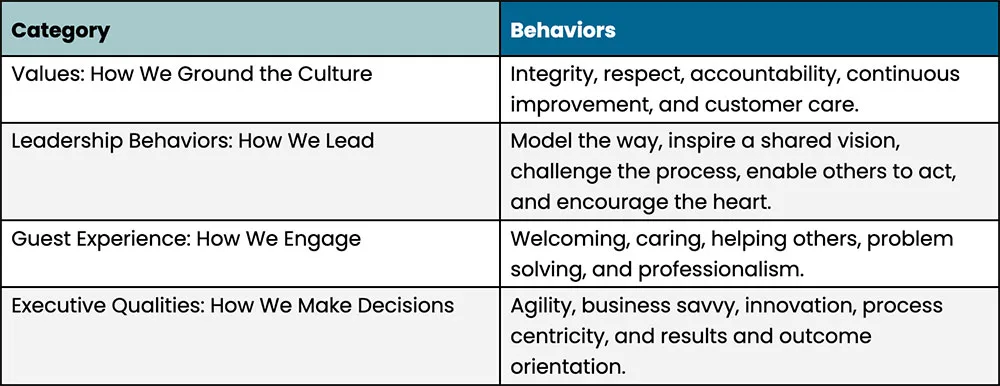
The point is not to make culture more complicated. The point is to make culture visible, teachable, and accountable. If we say integrity matters, then it must show up in performance conversations. If we say continuous improvement matters, then people need tools to improve processes. If we say everyone is a leader, then people must be empowered to challenge the process and make decisions within their scope.
I often tell leaders that every behavior is culture-making. There is no such thing as culturally neutral behavior. The way we listen, the way we make decisions, the way we recognize effort, the way we respond under pressure, and the way we handle mistakes all teach the organization what is truly valued.
Listen First. The Answers Are Usually in the Organization.
Many leaders feel pressure to be out front, to be forceful, to have the answer, and to make their opinions known quickly. My own view is almost the opposite. I see leadership as standing behind people and helping them become their best. That begins with listening.
Listening is not a passive act. It is a discipline. We listen through annual team member surveys. We listen through small group forums. We listen through 360 feedback. We listen through two-way communication channels across departments. We listen to what people say, and we also look carefully at what the organization is showing us through behavior, process, performance, and morale.
That is what I mean by listen, look, learn. When you listen long enough and observe carefully enough, you begin to understand what needs to change. You see where the organization is strong. You see where execution breaks down. You see where people are carrying friction that leaders may not have noticed. Then you can lead from a more informed place.
In my experience, leaders rarely have all the answers. The answers usually lie somewhere inside the organization. The leader’s responsibility is to create enough trust, structure, and humility for those answers to surface.
Calm Is a Leadership Skill.
The pandemic tested every leadership philosophy in real time. I began my role in January 2020, just before uncertainty became a daily operating condition. We had to close the resort, work out how to reopen it, develop cleaning protocols, introduce masks, deploy screening technology, and create systems we had never needed before. We built a Safe and Well program and relied on people throughout the organization to solve problems quickly and responsibly.
What I learned, or perhaps relearned, was that people look to leaders for calm in times of adversity. Calm does not mean pretending the problem is small. It means staying steady enough to make good decisions, communicate clearly, and keep the organization focused on the next right action.
I reflected during that time on personal hardships in my own life and on the hardship tribal nations have endured. Tribes understand perseverance at a level many organizations only talk about. Out of adversity can come courage, but courage is more likely to emerge when leaders create steadiness, clarity, and shared purpose.
Culture Must Be Installed, Not Announced.
A culture statement is only the beginning. If values remain on posters, they will not change the business. To make values real, we have to build them into the operating system of the organization.
When we codified our values, we supported them with campaigns, videos, posters, training, onboarding, and performance appraisal systems. We reward people not only for job skills, but also for displaying the values. We also hold people accountable when behaviors are inconsistent with those values. Accountability is part of care. Without it, values become optional.
We have trained officers, executive directors, directors, managers, and hundreds of supervisors in leadership behaviors. We use 360 feedback and action plans so leaders understand what they are doing well, where they have opportunities to improve, and what they will work on before the next feedback cycle. I participate in that same process. Culture cannot be delegated. The senior team has to model it, measure it, and submit to it.
We also use peer-to-peer recognition so team members can reward one another for living the values. That matters because culture becomes stronger when recognition does not depend entirely on hierarchy. When peers notice and reinforce the right behaviors, the culture starts sustaining itself.
Continuous Improvement Gives People a Way to Act.
One of our values is continuous improvement. To make that practical, people need tools. We use Lean Six Sigma and have built capability across the organization with yellow belts, green belts, black belts, and master black belts. The purpose is not certification for its own sake. The purpose is to give people a method for improving the work in front of them.
We have seen team members reduce the time required to clean rooms, identify vendor savings, reduce the time it takes to place a slot machine on the gaming floor, and improve cost, quality, and timing outcomes in capital projects. Those improvements are not separate from culture. They are evidence that culture is working. Leadership behaviors empower people to challenge the process. Process excellence shows them how.
Growth mindset is easier to admire than to operationalize. Organizations stay curious and adaptable when they train people, expose leaders to new ideas, create forums for innovation, and make it safe to improve how work gets done.
Innovation Should Serve Purpose.
Innovation is not simply the pursuit of novelty. It should serve mission, performance, people, and community. We have explored artificial intelligence through governance and working groups, applying it in ways that support better analysis, documentation, and prediction. We also see innovation in environmental stewardship.
Our facilities team has helped create a certified zero-waste resort environment with a very high recycling rate. Materials that might otherwise be treated as waste can become outdoor furniture, biodiesel, or sound-dampening products. That kind of thinking reflects more than efficiency. It reflects a system view of stewardship. It asks a better question: what else could this become, and how can this work serve both the business and the environment?
That question aligns with tribal values. Tribal nations are inherently conscious of land, resources, and future generations. Business innovation is strongest when it is connected to that deeper sense of responsibility.
Measure the Culture You Intend to Build.
Culture can feel hard to measure, but leaders should still measure what they can. We look at team member survey participation and engagement scores. We look at voluntary turnover. We look at customer experience. We look at hotel satisfaction scores, open positions, appraisal performance, and other indicators that tell us whether the culture is helping people do better work.
Metrics do not capture every act of care, but they do tell a story. I also pay attention to the human examples: team members donating sick leave to a colleague facing a health challenge, someone driving a forgotten cell phone back to a guest, letters from guests naming team members who delivered exceptional service. Those moments reveal whether the culture has moved from language into instinct.
Legacy Is Built One Life at a Time.
For me, legacy means leaving what I inherited in a better place. It means Tribal Enterprises become more resilient. It means team members advance in their careers. It means tribal programs and outcomes expand. It means more people can say, years from now, that someone helped them grow.
Legacy is not only what an organization accomplishes. It is how the organization learns to accomplish it. A culture that can weather storms, develop leaders, improve processes, serve guests well, and remain anchored in mission is a culture that can outlast any one leader.
My advice to the next generation of leaders is simple, though not always easy. Do not be afraid to make mistakes; failure is not fatal if you learn from it. Put yourself in uncomfortable situations because that is where growth occurs. Do not try to grow alone; seek mentors and people who will help you see what you cannot see. Build culture consciously because culture enables every outcome, financial or otherwise. Be transparent because trust is earned, not commanded. And always focus on leaving something better than you inherited it.
How you lead will be your legacy. If you lead by listening, observing, learning, empowering, improving, and caring, then the work becomes larger than a role. It becomes a contribution to people, community, and the generations still to come.
Source note: Adapted from John Elliott’s interview on Expressions of Leadership, Episode 14, published June 17, 2025, and the accompanying thematic framework identifying Family Culture inside Business Culture.